

Spoiler Alert: this piece gives away the ending to A&E’s & Netflix’s “Alone Australia” - if you’re watching that and don’t want the ending spoiled, skip this piece.
It was likely the summer of second grade, which would make me eight and my sister, Lindsey, six. She, my mom, and I were in Maine, taking a weekend to go to her father’s beach house in Saco.
We stopped for donuts. Either my sister or I had to pee, so we both went to the bathroom, but I remember once we got in, I locked the door. We did what we had to do, and then, after washing our hands, I attempted to get us out of the locked door and failed.
And failed.
And failed.
I’m going to say that we both tried multiple times, but given our age and my kiddo headspace, if Lindsey told me I never let her have a crack at it, I’d believe her.
What I remember is worrying we were stuck, and at some point we both started slamming all of our tens of pounds against the door, slapping it with our flat hands and screaming for our Mom.
I do remember Mom coming to the door with what sounded like an employee, and the two of them attempting to guide us through how to successfully unlock the lock. All the while, my brain was forging a plan of how my sister and I would spend the rest of our natural lives together in that small bathroom.
At least we had water and a toilet.
After what I remember feeling like tens of hours, which I’m sure was only minutes, and potentially only seconds, the door opened, and we both flung ourselves into our Mom’s arms.
I was never scared of being alone. Aside from being with my sister, I’ve never really felt alone, because my neurodivergent brain would never allow for it.
Now, trapped, that’s something else.
Being trapped has always felt real, and being trapped with minimal resources was even worse, because while I could make songs and stories in endless supply, eventually I’d run out of paper products for props and biological use.
Cancer has never made me feel alone. For starters, there are too many people, sadly, who are also diagnosed. There’s some devastating statistic that 1 out of every 2 Americans will be impacted by cancer, either with a direct diagnosis, like me, or through the direct diagnosis of an immediate family member, like everyone in my immediate and extended family.
It’s difficult to feel alone with stats like that, but far too easy to feel trapped.
Trapped in toxic practices. I mean, I’m still driving around in a gas-powered car and using disposable cups when the house is full. How can I really be upset with the Earth fighting for her life the best way she knows how: kill the humans.
Clearly, there are about a zillion other ways I could curb my existence to be better for the Earth, but even listing them feels boring, for both you and me.
Trapped in financial uncertainty. The whole truth is, a few years after I separated from my husband, I bought a house with all my own money and kept it afloat with all of my own money as well.
But just always just afloat.
Then, I got terminal cancer during a time when I had just started out in entrepreneurship. As many new entrepreneurs in America will attest, benefits, such as health, dental, and life insurance, are not the best when you start building a business.
Oh, and the day I came home from brain surgery, my hot water heater blew...and my oil tank cracked.
How I wish the timing for that busted hot water heater and oil tank were exaggerations.
I took both as a warning from the house:
Amanda, you may survive this season, but your cute little home in this quaint little neighborhood will not.
I refused to lose the house, so, ultimately, I decided to sell. There is a difference.
Fortunately, I had a place to go. Todd, my forever boyfriend, took my family and me in lovingly and without hesitation.
But I’m nowhere near paying, financially, half of what it costs to keep things up and running.
Trapped in size. I’ve been self-publishing for more than ten years. Before here on Substack, on amandathanks.com, a gratitude blog that did little more than help get some things out of my head and into the ether.
No book deals. No viral posts. No undeniable external validation that it mattered.
And if I’m all the way honest, at some points, even here on Cancer Sharks, I’ve had serious internal battles about whether my writing matters.
Then, I watched Alone Australia.
Alone, if you don’t know, is a reality television show for survivalists. Ten people are boated off to uninhabited places, in this case, Southern New Zealand, with nothing but their bows and arrows, clothes, backpacks, and ten survival items they’re allowed to pick. Can’t be a gun.
The one who stays out the longest wins $250,000 and bragging rights. Contestants can tap out whenever they want. If you want to watch the series, it’s streaming on Netflix right now, and even if you don’t, here’s how it ends:
The openly neurodivergent dude wins.
Not because he had the most protein. He didn’t.
Not because he explored the most land. He didn’t.
Not because he managed never to get sick. He didn’t.
Not because he had the best sleep. He maybe had the worst.
But because he prioritized his mind.
Some days, all he did was make rope out of leaves. He used sticks to make a spinning wheel and spun beach debris into this yarn-like substance to weave things he didn’t really need.
He told his brain he wouldn’t quit. He would accept fate, say, if he got medically extracted, but he would not quit.
Instead, he would make things.
Keep his busy mind useful.
Say nice things to himself and never really be alone.
And he won.
And I know, this is just one sorta silly TV show that literally brings humans to their brink for...sport. Can we call it sport? I guess.
And being locked in that bathroom wasn’t really traumatic.
But maybe the sum of all these things is greater than its parts.
Because when I was eight years old and thought I might spend the rest of my natural life trapped in a donut-shop bathroom, my brain immediately started figuring out what I could make.
Songs and stories in endless supply.
Decades later, I watched another neurodivergent brain respond to being trapped by making rope out of leaves and weaving things he didn’t really need.
And somewhere in between, I spent more than ten years making things too.
Stories.
Blogs.
Cancer Sharks.
No guarantee of a book deal. No guarantee of a viral post. No undeniable external validation that any of it mattered. Maybe that’s not the only way to measure whether something matters.
Maybe being trapped is inevitable. In a bathroom. In cancer. In finances. In a body. In the size of whatever you’re trying to build.
And maybe the way through isn’t always getting yourself out.
Sometimes, it’s keeping your busy mind useful.
Sometimes, it’s saying nice things to yourself.
Sometimes, it’s making rope out of leaves.
And sometimes, it’s making songs and stories in endless supply.
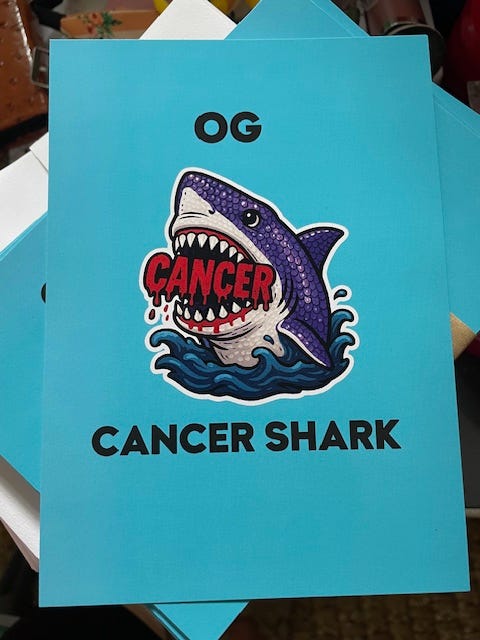
Or crocheted chickens!
Or building a jeep, or just walking the beach with your best friend and the dogs. We’re all trapped in this thing called life. I’m so glad to be able to go through it all together with you. ❤️🦈💪